Special Exceptions – Safety and Health+
The subject of safety and health is addressed in Article 14 of the National Agreement. Safety and health of employees is very important to the Postal Service and the NALC for obvious reasons and contractual provisions throughout Article 14 outline procedures that have been negotiated and put into place to promote a safe and healthy work environment. To ensure this safe and healthy environment, some special exceptions to the normal rules of the DRP have been negotiated to address unsafe and unhealthy situations in a timely manner. The focus of this section of the guide will be to discuss these special exceptions to the DRP as well as the procedures for reporting and correcting unsafe and unhealthy conditions.
Article 14, Section 2 of the National Agreement provides the controlling language that outlines the proper procedures for reporting and correcting unsafe conditions or unsafe procedures in the workplace. That section of the National Agreement reads as follows:
The Employer and the Union insist on the observance of safe rules and safe procedures by employees and insist on correction of unsafe conditions. Mechanization, vehicles and vehicle equipment, and the work place must be maintained in a safe and sanitary condition, including adequate occupational health and environmental conditions. The Employer shall make available at each installation forms to be used by employees in reporting unsafe and unhealthful conditions. If an employee believes he/she is being required to work under unsafe conditions, such employee may:
(a) notify such employee’s supervisor who will immediately investigate the condition and take corrective action if necessary;
(b) notify such employee’s steward, if available, who may discuss the alleged unsafe condition with such employee’s supervisor;
(c) file a grievance at Formal Step A of the grievance procedure within fourteen (14) days of notifying such employee’s supervisor if no corrective action is taken during the employee’s tour; and/or
(d) make a written report to the Union representative from the local Safety and Health Committee who may discuss the report with such employee’s supervisor.
Upon written request of the employee involved in an accident, a copy of the PS Form 1769 (Accident Report) will be provided.
Any grievance which has as its subject a safety or health issue directly affecting an employee(s) which is subsequently properly appealed to arbitration in accordance with the provisions of Article 15 may be placed at the head of the appropriate arbitration docket at the request of the Union.
Article 14, Section 2 provides a special priority for the handling of safety and health issues, providing for cooperative correction of unsafe conditions and enforcement of safety rules, and requiring special handling of individual safety issues as they arise. Documenting the unsafe condition, notifying the supervisor, and following up to see if any action is taken to correct the situation is vital to resolving the problem.
A few examples of unsafe or unhealthy conditions in the workplace which should be corrected under the guidelines of Article 14, Section 2 are:
- A fire extinguisher on the workroom floor which is being blocked by the staging of empty equipment.
- Ungrounded electrical outlets.
- Frayed or exposed wiring on a letter carrier’s case.
- The staging of mail or equipment which creates a tripping hazard.
- A delivery point which requires an unsafe backing situation.
- An unsanitary situation in your office.
- Unsafe park points.
Obviously these examples do not include all instances of unsafe or unhealthy conditions, but they give you an idea of what types of incidences should be reported to USPS management by letter carriers or stewards for immediate corrective action.
An employee who believes that he or she is being required to work under unsafe conditions may notify the supervisor or the employee’s steward. Alternatively, a written report of the problem may be given to the union representative from the local Safety and Health Committee, who may discuss the report with the supervisor. Notifying the supervisor of an unsafe condition can be done in a variety of ways but it should be done in writing. Document how you informed him or her. While it is not required, a good way to do so is via a PS Form 1767, Report of Hazard, Unsafe Condition or Practice. These forms are displayed in your office in a manner which employees can have easy or anonymous access to the form to report any hazard, unsafe condition, or practice. They have a section for the employee to fill out and then give to his or her immediate supervisor. From there, the supervisor is required to investigate the specified condition within the tour of duty of the report being filed. The supervisor must take immediate corrective action on the safety issue or make appropriate recommendations on the PS Form 1767, forward the PS Form 1767 to the responsible manager, and send a copy to the safety office. Using PS Form 1767 to document safety issues can also help you prove the facts of your case in a safety-related grievance. A copy of PS Form 1767 is provided for your review on the following page.
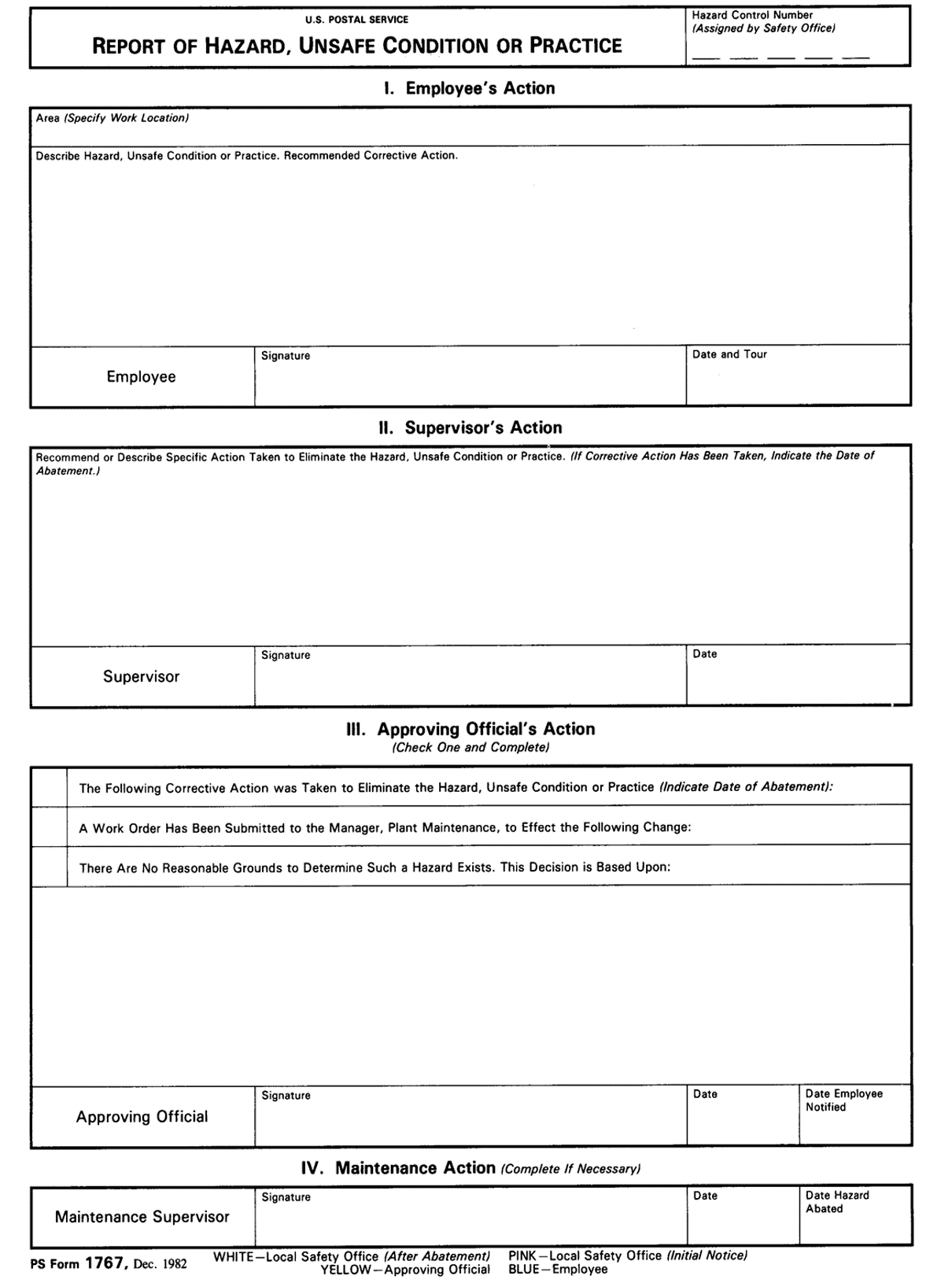
Article 14, Section 2 also provides that safety grievances may be filed directly at Formal Step A of the grievance procedure. If no action is taken to correct the problem after notification of the supervisor, the matter may be grieved directly at Formal Step A within 14 calendar days of such notification. However, if a grievance for one of these subjects is filed at Informal Step A instead, it is not procedurally defective for that reason.
Caution: This does not mean that health or safety grievances can be grieved directly to Formal Step A to bypass an employee's supervisor. It only means that a grievance can be filed directly to Formal Step A if, after notifying an employee's supervisor, "no corrective action is taken during the employee’s tour." When in doubt about what to do with cases involving safety and health issues, seek advice from branch officers or your branch president. In the meantime, you may file the grievance at Informal Step A as you would with any other grievance. This may give you time to gather more evidence for your grievance file.
Another special exception to the normal DRP regarding grievances involving safety and health disputes involves the arbitration procedure. Grievances with this subject may receive priority arbitration scheduling. Article 14, Section 2 of the 2014 JCAM on page 14-2 explains this provision as such:
Priority Arbitration Scheduling. Any grievance which has as its subject a safety or health issue directly affecting an employee(s) which is subsequently properly appealed to arbitration may be placed at the head of the appropriate arbitration docket at the request of the union. The Postal Service will not refuse to schedule a case in accordance with Article 14.2 based solely upon the belief that no safety issue is present. However, placement of a case at the head of the arbitration docket does not preclude the Postal Service from arguing the existence of the alleged “safety” issue or that the case should not have been given priority (Prearbitration Settlement F94N-4FC 97024971, February 20, 2001, M-01433).
Remember, the provisions of Article 14, Section 2 were put into the National Agreement to help create a safe and healthy environment in which letter carriers can work. One of your roles as a steward is to make sure that these procedures are followed and therefore ensure a workplace free of unsafe conditions.
Special Exceptions – Discrimination +
Article 2 of the National Agreement forbids discrimination against employees because of race, color, creed, religion, national origin, sex, age, marital status, or physical handicap where the employee can be reasonably accommodated. Article 2 also gives letter carriers the contractual right to object to and remedy alleged discrimination by filing a grievance.
An exception to the normal steps of the DRP is also contained in Article 2 of the National Agreement. This exception to the DRP provides that grievances alleging discrimination may be filed directly at Formal Step A of the grievance procedure, rather than being initiated at Informal Step A. It is not a requirement to go directly to the Formal Step A level of the grievance procedure in discrimination grievances; it is an option. However, if a grievance concerning discrimination is filed at Informal Step A, it is not procedurally defective for that reason. The contractual language governing this exception to the rules can be found in Article 2, Section 3 of the National Agreement which states the following:
Section 3. GrievancesGrievances arising under this Article may be filed at Formal Step A of the grievance procedure within fourteen (14) days of when the employee or the Union has first learned or may reasonably have been expected to have learned of the alleged discrimination, unless filed directly at the national level, in which case the provisions of this Agreement for initiating grievances at that level shall apply.
Caution: Discrimination grievances can be filed under Article 2, but when you do so this is a contract case which requires the union to bear the burden of proof. Remember, grievances with Article 2 discrimination violations should always have evidence to show the alleged discrimination occurred. Do not cite Article 2 in disciplinary grievances. Disciplinary grievances should be filed under Article 16 which requires management to bear the burden of proof.
Various USPS handbooks and manuals also contain provisions that deal with Postal Service policy regarding discrimination in the workplace. Often these handbook and manuals will provide another avenue to consider for addressing an issue. If you represent a letter carrier who feels they may have been discriminated against, you should also refer them to posters and literature in every Post Office which have Equal Employment Opportunity Commission (EEOC) filing information. If you need further guidance concerning discrimination or if you need further clarification, then you should immediately seek assistance from your union officers and branch president.
The provisions of Article 2, Section 3 were put into the National Agreement to help create a timely process to address alleged instances of discrimination and to facilitate a discrimination free work environment in which letter carriers can work. One of your roles as a steward is to assist the letter carriers you represent when they feel they are being discriminated against. Although the burden of proving discriminatory actions by the Postal Service can be very daunting at times, this role is of the utmost importance to the letter carriers you represent and it is very rewarding to know that you are ensuring that everybody is afforded the same opportunities.
Special Exceptions—MSPB Appeal Rights +
Background
The Veterans' Preference Act guarantees "preference eligible" employees certain special rights concerning their job security. A preference eligible employee may file both a grievance and a Merit System Protection Board (MSPB) appeal on a proposed removal or suspension of more than 14 days. The rights of preference eligible employees to appeal certain adverse actions to the MSPB or through the grievance arbitration procedure are the subject of Article 16, Section 9 of the National Agreement which provides the following:
Section 9. Veterans’ Preference A preference eligible is not hereunder deprived of whatever rights of appeal are applicable under the Veterans’ Preference Act. If the employee appeals under the Veterans’ Preference Act, however, the time limits for appeal to arbitration and the normal contractual arbitration scheduling procedures are not to be delayed as a consequence of that appeal; if there is an MSPB appeal pending as of the date the arbitration is scheduled by the parties, the grievant waives access to the grievance-arbitration procedure beyond Step B.
Page 16-10 of the 2014 Joint Contract Administration Manual provides the following explanation of Article 16.9:
MSPB Dual Filings. The Veterans’ Preference Act guarantees “preference eligible” employees certain special rights concerning their job security. (Federal law defines a “preference eligible” veteran at Title 5 United States Code Section 2108; see EL-312, Section 483). A preference eligible employee may file both a grievance and an MSPB appeal on a removal or suspension of more than fourteen days. However, Article 16.9 provides that an employee who exercises appeal rights under the Veterans’ Preference Act waives access to arbitration when they have an MSPB appeal pending as of the date the grievance is scheduled for arbitration by the parties. The date of the arbitration scheduling letter is considered “the date the arbitration is scheduled by the parties” for the purposes of Article 16.9.
This language has been modified to reflect the parties’ agreement that an employee should receive a hearing on the merits of an adverse action. It supercedes the 1988 Memorandum of Understanding on Article 16.9. While a preference eligible city letter carrier may appeal certain adverse actions to the MSPB, as well as file a grievance on the same action, the employee is not entitled to a hearing on the merits in both forums. This provision is designed to prevent the Postal Service from having to defend the same adverse action in an MSPB hearing as well as in an arbitration hearing. If a city letter carrier has an MSPB appeal pending on or after the date the arbitration scheduling letter is dated, the employee waives the right to arbitration.
The parties agree that the union will be permitted to reactivate an employee’s previously waived right to an arbitration hearing if that employee’s appeal to the MSPB did not result in a decision on the merits of the adverse action, or the employee withdraws the MSPB appeal prior to a decision on the merits being made. It is understood that this agreement does not preclude the parties from raising other procedural issues from the original arbitration appeal. Additionally, the Union is not precluded from raising as an issue in arbitration whether any Postal Service backpay liability should include the period between the time the right to arbitration was waived by the employee and the time the Union reactivated the arbitration appeal.
EEO and EEO/MSPB Mixed Cases—Dual Filings. Article 16.9 does not bar the arbitration of a grievance where a grievant has asserted the same claim in an Equal Employment Opportunity (EEO) complaint. Nor does it apply where a preference eligible grievant has appealed the same matter through the EEOC and then to the MSPB under the “mixed case” federal regulations (National Arbitrator Snow, D90N-4D-D 95003945, January 1, 1997, C-16650)
Keep in mind that the provisions of Article 16.9 apply to all “adverse actions,” as defined by 5 USC §7512, otherwise appealable to the MSPB. This includes involuntary resignation or involuntary retirement, which have been defined as constructive removal, and enforced leave (in excess of 14 days) which has been defined as constructive suspension. See C-18158, National Arbitrator Das, November 12, 1997 and USPS Policy Memorandum M-01154.
Article 16.5 of the National Agreement provides preference eligible employees with certain rights governing special procedures in the issuance of suspensions greater than 14 days or removal. Page 15-6 of the 2014 Joint Contract Administration Manual provides the following explanation in Article 15.2 of these special procedures for preference eligible employees:
Preference Eligible Employees. Grievances concerning proposed removal actions which are subject to the thirty day notification period in Article 16.5 will be held at Formal Step A of the grievance procedure until the decision letter is issued.
Consistent with the Dispute Resolution Process Memorandum, the employee will remain on the job or on the clock until after the Step B decision has been rendered or 14 days after the appeal is received at Step B, except for emergency or crime situations as provided for in Articles 16.6 and 16.7.
The union does not file a separate grievance on the decision letter. Rather, the union may make additions to the file based on the decision letter at either Step A or Step B. This does not preclude any arguments by management regarding the relevance of the additions.
Grievances concerning proposed removal actions which are not subject to the thirty day notification period in Article 16.5 are not held at the Formal A step pending receipt of the decision letter. Rather, the union may later add the decision letter to the proposed removal grievance. This does not preclude any arguments by management regarding the relevance of the additions.
The Basic Rule
Cases involving “preference eligible” employees who have MSPB appeal rights can raise confusing issues because they receive both a letter of “proposed” action and a “final decision” letter. These issues are discussed below.
For the purposes of Informal Step A of the grievance procedure, treat a letter of “proposed” removal exactly the same as any other discipline. Observe the same time limits and do not wait for a “final decision” letter to initiate the grievance at Informal Step A or to appeal a grievance to Formal Step A. Just pretend the word “proposed” doesn’t exist.
Proposed Discipline v. Decision Letter
As noted above, under the MSPB procedures, preference eligible employees must first be issued a letter of proposed discipline and then a final decision letter after they have been given the opportunity to respond to the charges. A grievance should be filed at the time a preference eligible employee receives a Letter of Proposed Discipline. It is not necessary to file a separate grievance concerning the Decision Letter. Anytime you see a discipline notice that has the word “proposed” in the type of discipline, just pretend the word “proposed” isn’t there. For instance, if you have a “proposed removal” case, treat it the same as you would if it were a regular removal case. File a grievance within 14 calendar days of the day the proposed removal is received by the grievant. This same rule applies to any “proposed” adverse action. If you just pretend the word “proposed” isn’t there, you’ll never go wrong.
As previously stated, here is an easy way to remember it:
Anytime you see a discipline notice that has the word “proposed” in the type of discipline, just pretend the word “proposed” isn’t there. For instance, if you have a “proposed removal” case, treat it the same as you would if it were a regular removal case. File a grievance within 14 calendar days of the day the proposed removal is received by the grievant. This same rule applies to any “proposed” adverse action. If you just pretend the word “proposed” isn’t there, you’ll never go wrong.
The NALC does not represent letter carriers in MSPB proceedings. Furthermore, letter carriers who choose to appeal an adverse action to the MSPB lose some of the procedural protections provided by the National Agreement. For example:
- Expired Discipline. Article 16, Section 10 provides that the records of a disciplinary action against an employee shall not be considered in any subsequent disciplinary action if the grievant has no disciplinary action(s) in their record for a period of two years. This contractual protection does not apply to the MSPB proceeding. In fact, the Postal Service routinely relies upon discipline that cannot be considered in the grievance-arbitration procedure when defending adverse actions in MSPB cases.
- Unadjudicated Discipline. Under the National Agreement, an arbitrator may not consider past discipline that has been grieved but not yet resolved or adjudicated. See JCAMArticle 16 and C-03910, National Arbitrator Fasser, June 18, 1977. This contractual protection does not apply to MSPB proceedings which have different procedural rules (United States Supreme Court United States Postal Service v. Gregory, 534 U.S. 1, 122 S. Ct. 431 (2001)).
If you are unsure about an MSPB-related issue, seek guidance from a branch officer or your branch president. The Postal Service employs a large number of preference eligible veterans in the letter carrier craft. As a steward you will undoubtedly have a chance to put the skills you learned here to work for them.
Time Limits +
Every step of the grievance-arbitration procedure has firm time limits. These time limits are absolute. See the Grievance Procedure Chart on page 24 of this guide to further understand these time limits. It is the union’s responsibility to make sure the time limits are met at each step of the procedure.

Stewards should make sure the letter carriers they represent understand the importance of contacting the union immediately if they receive any discipline―including letters of warning. All letter carriers should understand that the time limits begin when they receive the discipline, not when they notify the union. They should also understand that if discipline, such as a letter of warning or no-time-off suspension, is not grieved when it is received, then it will not be possible to challenge it later if it is cited as a prior element of discipline in a future disciplinary action.
Informal and Formal Step A
Article 15, Section 2 of the National Agreement establishes a 14 calendar day time limit for filing a grievance at Informal Step A. Fourteen days means 14 calendar days, not 14 work days. For example: if a grievant receives a letter of warning, day one of the 14 calendar days is the day after the letter of warning is received. This is true even if, for example, the fourteenth day falls on a Sunday. In that case Sunday would be the last day that a timely grievance could be filed. It is never a good idea to wait until the last day to file a grievance because errors in counting days or other problems can easily result in a grievance being untimely. The language from the National Agreement reads as follows:
Article 15.2. Informal Step A (a) Any employee who feels aggrieved must discuss the grievance with the employee's immediate supervisor within fourteen (14) days of the date on which the employee or the Union first learned or may reasonably have been expected to have learned of its cause. This constitutes the Informal Step A filing date.
The responsibility to meet time limits continues past the Informal Step A meeting. If a grievance is not resolved at the Informal Step A meeting, the union has 7 calendar days to appeal the grievance to Formal Step A. Management then has 7 calendar days from the date they received the Formal Step A appeal to schedule a meeting with the union and meet at Formal Step A. If the case is not resolved at the Formal Step A meeting or no meeting is scheduled, the union has 7 calendar days from the date the meeting took place (or should have taken place) to appeal the case to Step B. You should consider keeping copies of postmarks or meter strips as well as receipts to make sure you can prove that time limits were adhered to in an appeal to Formal Step A.
Page 15-2 of the 2014 JCAM explains this Section as follows:
An employee or union representative must discuss the grievance with the employee's immediate supervisor within fourteen calendar days of when the grievant or the union first learned, or may reasonably have been expected to learn, of its cause. The date of this discussion is the Informal Step A filing date.
Time Limits. The fourteen days for filing a grievance at Informal Step A begin the day after the occurrence or the day after the grievant or the union may reasonably have been expected to have learned of the occurrence. For example, if a grievant receives a letter of warning, day one of the fourteen days is the day after the letter of warning is received.
Page 15-2 of the 2014 JCAM continues to explain an exception to this rule in regards to continuing violations. In H1N-5D-C 297, June 16, 1994 (C-13671), National Arbitrator Mittenthal explained the theory of continuing violations as follows:
Assume for the moment, consistent with the federal court rulings, that the Postal Service incorrectly calculated FLSA overtime for TCOLA recipients under the ELM. Each such error would have been a separate and distinct violation. We are not dealing here with a single, isolated occurrence. Management was involved in a continuing violation of the ELM. The affected employees (or NALC) could properly have grieved the violation on any day the miscalculation took place and such grievance would be timely provided it was submitted within the fourteen-day time limit set forth in Article 15. This is precisely the kind of case where a "continuing violation" theory seems applicable. To rule otherwise would allow an improper pay practice to be frozen forever into the ELM by the mere failure of some employee initially to challenge that practice within the relevant fourteen-day period.
Extension of Time Limits
The parties may, by mutual agreement, agree to extend the time limits for filing or processing a grievance. It is not contractually required that such extensions be in writing, but the NALC Contract Administration Unit strongly recommends that any extensions of time limits be in writing and signed by both parties. See the sample Time Limits Extension Form in the Sample Forms for Stewards chapter starting on page 107 of this guide. All too often, disputes arise concerning oral extensions of time limits. Sometimes these disputes arise because of misunderstandings about exactly what grievance was involved or how long the time limits were extended. You can avoid these kinds of problems by putting your time limit extensions in writing. Time limit extensions should be the exception rather than the rule. You will see this over and over throughout this guide. This is because it is normally in the best interests of the grievant and the union to process grievances within the prescribed time limits instead of delaying justice for the grievant by extending time limits.
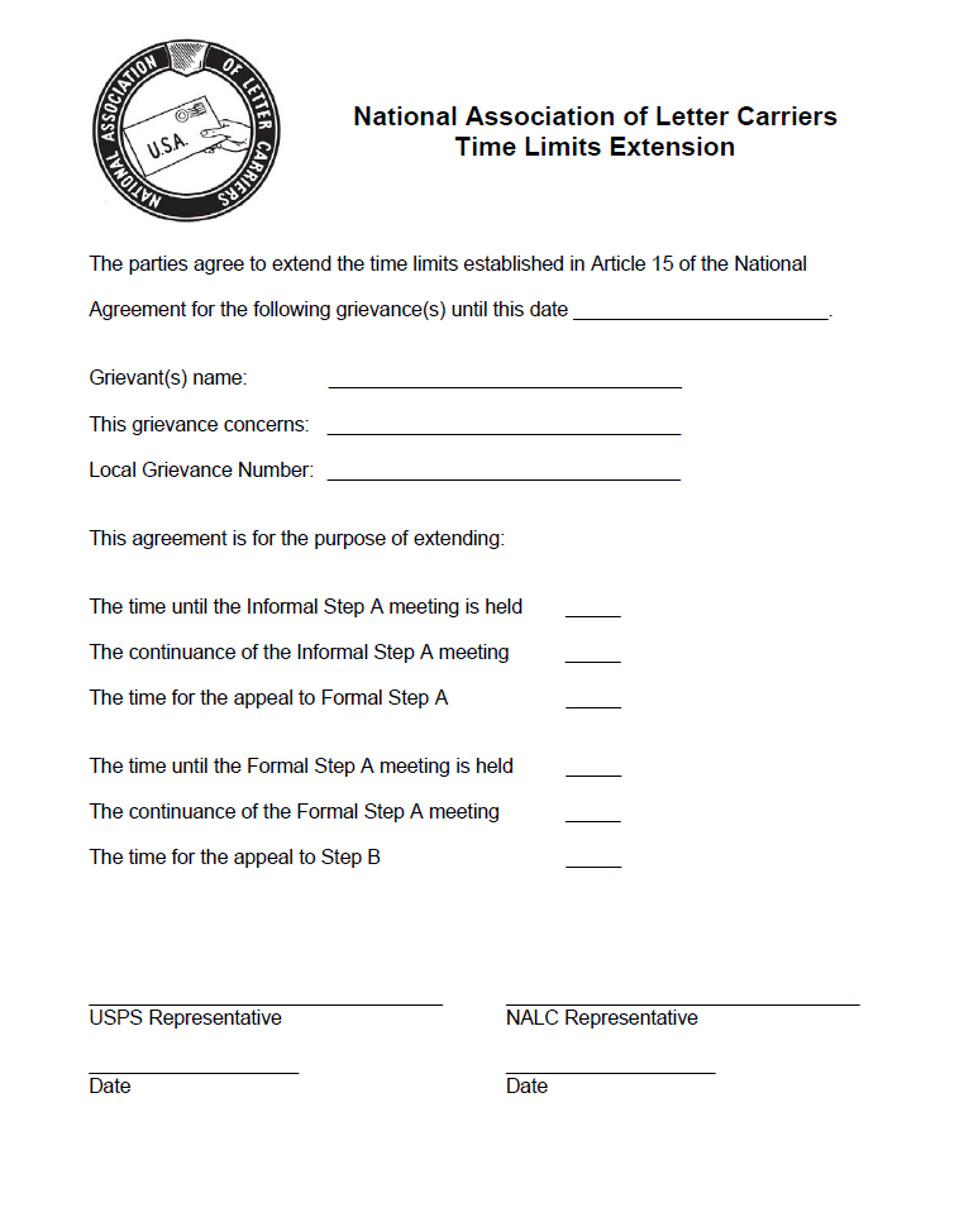
If you do not meet the time limits outlined in the National Agreement when you are processing and meeting on grievances, then the National Agreement further explains that failure shall be considered a waiver of the grievance. That means the merits of the grievance could no longer be heard, because the time limits to meet on the grievance had not been met. Article 15, Section 3.B addresses this as such:
Article 15.3.B. The failure of the employee or the Union in Informal Step A, or the Union thereafter to meet the prescribed time limits of the Steps of this procedure, including arbitration, shall be considered as a waiver of the grievance. However, if the Employer fails to raise the issue of timeliness at Formal Step A, or at the step at which the employee or Union failed to meet the prescribed time limits, whichever is later, such objection to the processing of the grievance is waived.
Page 15-11 of the 2014 JCAM explains the waiver of time limits mentioned above as follows:
If management fails to raise the issue of timeliness, in writing, at Formal Step A, or at the step at which the employee or Union failed to meet the prescribed time limits, whichever is later, it waives the right to raise the issue at a later time. Management's obligations depend upon the step at which it asserts the grievance was untimely.
- f management asserts that a grievance is untimely filed at Informal Step A, it must raise the issue in the written Formal Step A decision (because Formal Step A is “later” than Informal Step A) or the objection is waived. It is not sufficient to assert during the Informal Step A meeting that a grievance is untimely.
- If management asserts that a grievance is untimely at Formal Step A or later, it must raise the objection in the written decision at the step at which the time limits were not met.
The union is responsible for ensuring that the time limits outlined in the National Agreement have been met throughout the DRP. In other words, the union is the moving party and must maintain the time limits and appeal unresolved disputes to the next step of the DRP. This does not mean that management can interfere with this process though by failing to schedule a grievance meeting or failing to give the union a decision within the prescribed timelines. Article 15, Section 3.C addresses this with the following:
15.3.C Failure by the Employer to schedule a meeting or render a decision in any of the Steps of this procedure within the time herein provided (including mutually agreed to extension periods) shall be deemed to move the grievance to the next Step of the grievance-arbitration procedure.
Page 15-11 of the 2014 JCAM further clarifies this Section as follows:
Warning. Article 15.3.C can easily be misunderstood. It does not mean that grievances are automatically appealed if management fails to issue a timely decision. Rather, if management fails to issue a timely decision (unless the parties mutually agree to an extension) the union must appeal the case to the next step within the prescribed time limits if it wishes to pursue the grievance. In cases where management fails to issue a timely decision, the time limits for appeal to the next step are counted from the date management's decision was due.
Time Limits and Preference Eligible Employees
The rights afforded to preference eligible employees under the Merit System Protection Board (MSPB) have a tendency to complicate the understanding of time limits for stewards from time to time. Under the MSPB procedures, preference eligible employees who are issued discipline exceeding a 14 calendar day suspension must first be issued a letter of proposed discipline and then a final decision letter after they have been given the opportunity to respond to the charges. This can raise issues about time limits, which are discussed under MSPB Appeal Rights on page 75 of this guide. You should familiarize yourself with the MSPB section now.
Untimeliness Arguments Made by Management
What happens when management claims a grievance was filed untimely and the grievance reaches arbitration?
First, management must justify its claim that the grievance was in fact filed untimely by the union. If management is successful in proving that the timelines outlined in the National Agreement were not adhered to, then Arbitrators generally will not consider or hear the merits of an untimely grievance. However, arbitrators will decide in favor of hearing a grievance on its merits when there are improper claims by management that time limits were not met and the argument of untimeliness was not proven by management. This is why it’s important for you to document your adherence to grievance time limits outlined in the National Agreement. If there are any unusual circumstances that might explain a time limit argument made by management, explain them in detail by writing a steward’s statement and including it in the grievance file. Never let an untimeliness argument by management go unanswered. Always tell your side of the story.
Supporting Cases―Presumption that Grievance was Timely
The following arbitration decisions should be reviewed to give you a better understanding of time limits and for use by you in the event that management ever makes the claim that you failed to meet the time limits outlined in the National Agreement:
- C-00005 Arbitrator Cohen, July 3, 1979
- C-00009 Arbitrator Cohen, January 18, 1982
- C-04494 Arbitrator Dworkin, October 24, 1984
- C-05204 Arbitrator Rentfro, October 1, 1985
- C-06464 Arbitrator Collins, September 5, 1986
- C-08831 Arbitrator Nolan, May 17, 1989
Hopefully this Special Topics section has provided you with a better understanding of time limits and their importance to the DRP. You will hear numerous times throughout this guide the significance of meeting the DRP time limits. It cannot be overstressed though. The last thing you want to tell a letter carrier is that you lost their grievance because you failed to meet on or appeal their grievance in a timely manner.
Information Requests +
You will need to request information for almost every grievance you investigate or file because most of the documents needed to determine if a grievance exists and prove a contract violation are management records such as time records, work schedules, leave slips, curtail slips, reports, etc. Many times, you will also need to interview the grievant or someone that was a witness or involved in the matter you are investigating.
The best way to obtain any needed information such as documents, witness interviews, written statements, etc. is to simply request the information or interviews in writing.
As a steward, you have the right to request and obtain information by reviewing it, obtaining copies, or through interviews. Exercising these rights is an important part of your job as a steward. The information you include in a grievance file to document the facts of the case forms the foundation that will support your contentions and arguments as well as the remedy you are requesting. With a solid foundation you will be on your way to building a successful grievance.
When investigating to determine whether a grievance exists or when preparing to file a grievance, you will need to review information and evidence to determine exactly what happened. Articles 17 and 31 of the National Agreement give stewards the right to review and obtain copies of all relevant information needed to process a grievance.
In this section you will learn how to request information and interviews and what to do if management fails to grant your request in a timely fashion.
Article 31, Section 3 of the National Agreement gives stewards the right to request and receive information necessary to investigate and adjust grievances. That language reads:
Section 3. Information The Employer will make available for inspection by the Union all relevant information necessary for collective bargaining or the enforcement, administration or interpretation of this Agreement, including information necessary to determine whether to file or to continue the processing of a grievance under this Agreement. Upon the request of the Union, the Employer will furnish such information, provided, however, that the Employer may require the Union to reimburse the USPS for any costs reasonably incurred in obtaining the information.
Requests for information relating to purely local matters should be submitted by the local Union representative to the installation head or designee. All other requests for information shall be directed by the National President of the Union to the Vice President, Labor Relations.
Nothing herein shall waive any rights the Union may have to obtain information under the National Labor Relations Act, as amended.
That language from Article 31, Section 3 is explained on page 31-2 of the 2014 JCAM as such:
Information. Article 31.3 provides that the Postal Service will make available to the union all relevant information necessary for collective bargaining or the enforcement, administration or interpretation of the Agreement, including information necessary to determine whether to file or to continue the processing of a grievance. It also recognizes the union’s legal right to employer information under the National Labor Relations Act. Examples of the types of information covered by this provision include:
- attendance records
- payroll records
- documents in an employee’s official personnel file
- internal USPS instructions and memorandums
- disciplinary records
- route inspection records
- patron complaints
- handbooks and manuals
- photographs
- reports and studies
- seniority lists
- overtime desired and work assignment lists
- bidding records
- wage and salary records
- training manuals
- Postal Inspection Service Investigative Memoranda (IM)
- Office of Inspector General Report of Investigation (ROI)
To obtain employer information the union need only give a reasonable description of what it needs and make a reasonable claim that the information is needed to enforce or administer the contract. The union must have a reason for seeking the information —it cannot conduct a “fishing expedition” into Postal Service records.
Settlements and arbitration awards have addressed the union’s entitlement to information in certain specific areas. For example, the union has a right to any and all information which the employer has relied upon to support its position in a grievance (Step 4, H1C-3U-C-6106, November 5, 1982, M-00316). Note that the union also has an obligation to provide the Postal Service with information it relies upon in a grievance (Article 15). The union is also entitled to medical records necessary to investigate or process a grievance, even without an employee’s authorization, as provided for in Handbook AS-353, Guide to Privacy, the Freedom of Information Act, and Records Management and by Articles 17 and 31 of the National Agreement.
Our grievance procedure is document driven. The majority of grievances are settled based on documentary evidence and written statements alone. Without such evidence to support your facts and contentions, you are unlikely to be successful in your grievance.
Keep in mind that you are the best and often the only source of specific knowledge about the people involved and the day-to-day operations in your office. Make sure the information you include in the grievance file educates those who will handle the grievance after you. In other words, pretend you don’t know anything about your office as you determine what information to include in your grievance file.
Documenting grievance files with information you request is even more important if a grievance reaches Step B of the grievance procedure. This is where a team made up of one union member and one management member reviews case files in an attempt to resolve disputes. The Step B team reviews only the documents, statements, and the written facts and contentions contained in the grievance file submitted to them by the parties at the Formal Step A level of the grievance procedure.
The types and amount of information you need to document your facts and contentions will be determined by the nature of the specific case you are working on. You will be requesting information for both contractual and disciplinary grievances.
For example, consider the grievance of a full-time letter carrier not on the overtime desired list (ODL) required to work overtime when a letter carrier on the ODL was available. To properly investigate and document such a grievance, you should obtain at least:
- A copy of the overtime desired list for the current quarter
- Time records (Time and Attendance Control System (TACS) Employee Everything Reports)
- History of previous grievance settlements on this issue (if applicable)
The TACS Employee Everything Report is a useful document for many different types of grievances. All stewards should be familiar with reading this form. It shows all the employee moves, who made the move, at what time, and to what operation (office time, street time, steward time, etc). For a detailed explanation on how to read the TACS Employee Everything Reports, see pages 26-33 of the 2011 NALC Letter Carrier Resource Guide.
Depending on the specific circumstances, you may need other documents such as the work schedules, PS Forms 3996, PS Forms 1571, statements from the letter carrier or management officials involved, etc. There is no specific list for what will be needed for each grievance so be sure to tailor your request around the facts of your case.
You will also need information from management when defending a letter carrier in a disciplinary case. For example, if the grievance concerns attendance-related discipline, you may need to request PS Forms 3971 and 3972, a copy of the investigative interview, to interview any witnesses, etc. Again, exactly what you need to request will depend on the specific charges against the grievant. If you don’t know exactly what to ask for, seek the advice of those around you with more experience such as another shop steward, the NALC Formal A representative, or your branch president.
Requesting Information from Management
Information requests should be submitted in writing to the appropriate supervisor. It is also recommended that you use the same format for all of your requests. This will make your job easier and you will be less likely to miss any key information. Some NALC branches and regions have produced information request forms for use by their stewards.
This publication contains sample information request forms in the Sample Forms for Stewards chapter starting on page 107, one for Disciplinary Cases and one for Contract Cases. Please feel free to use these forms and modify them for your own use.
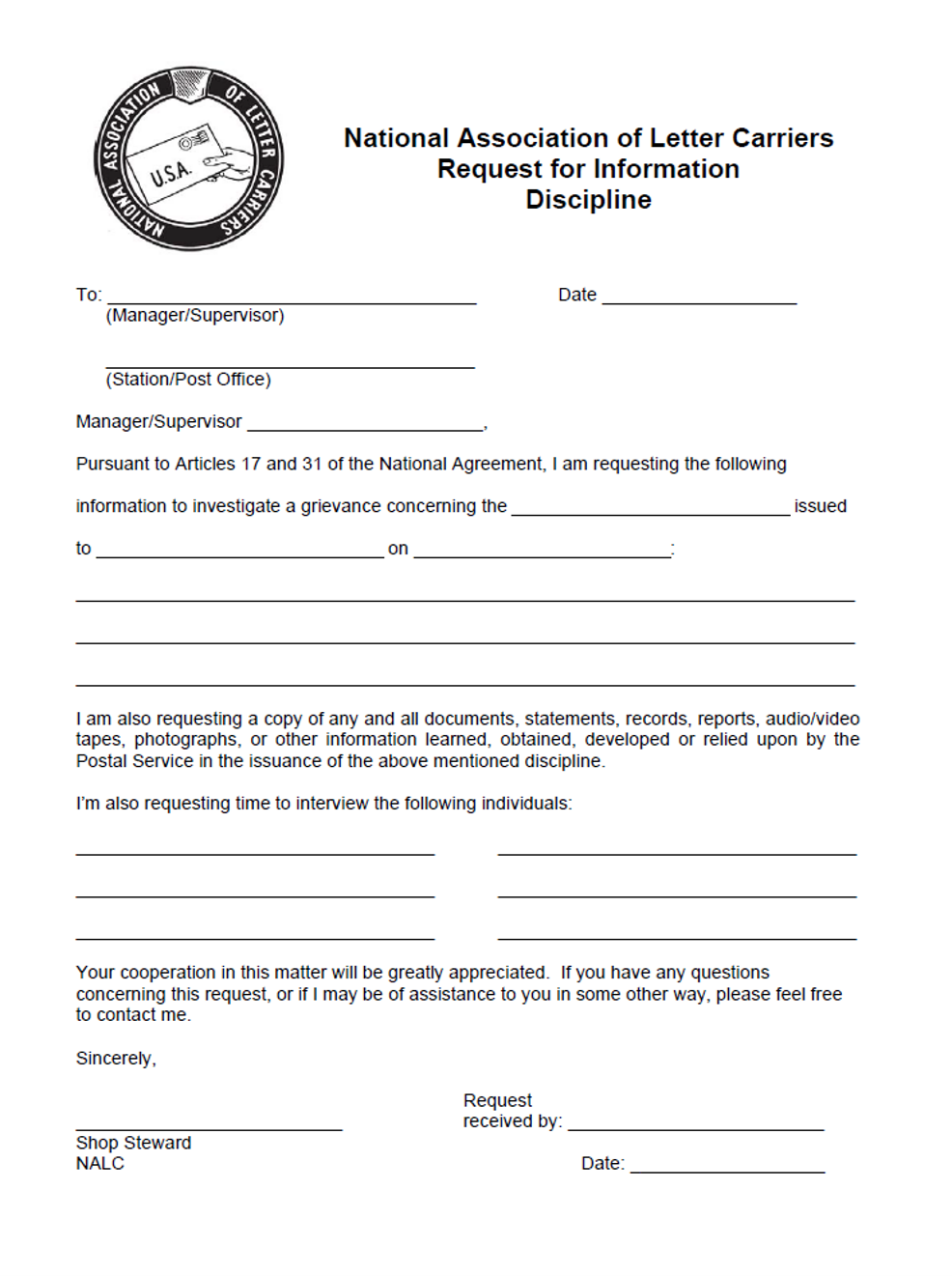
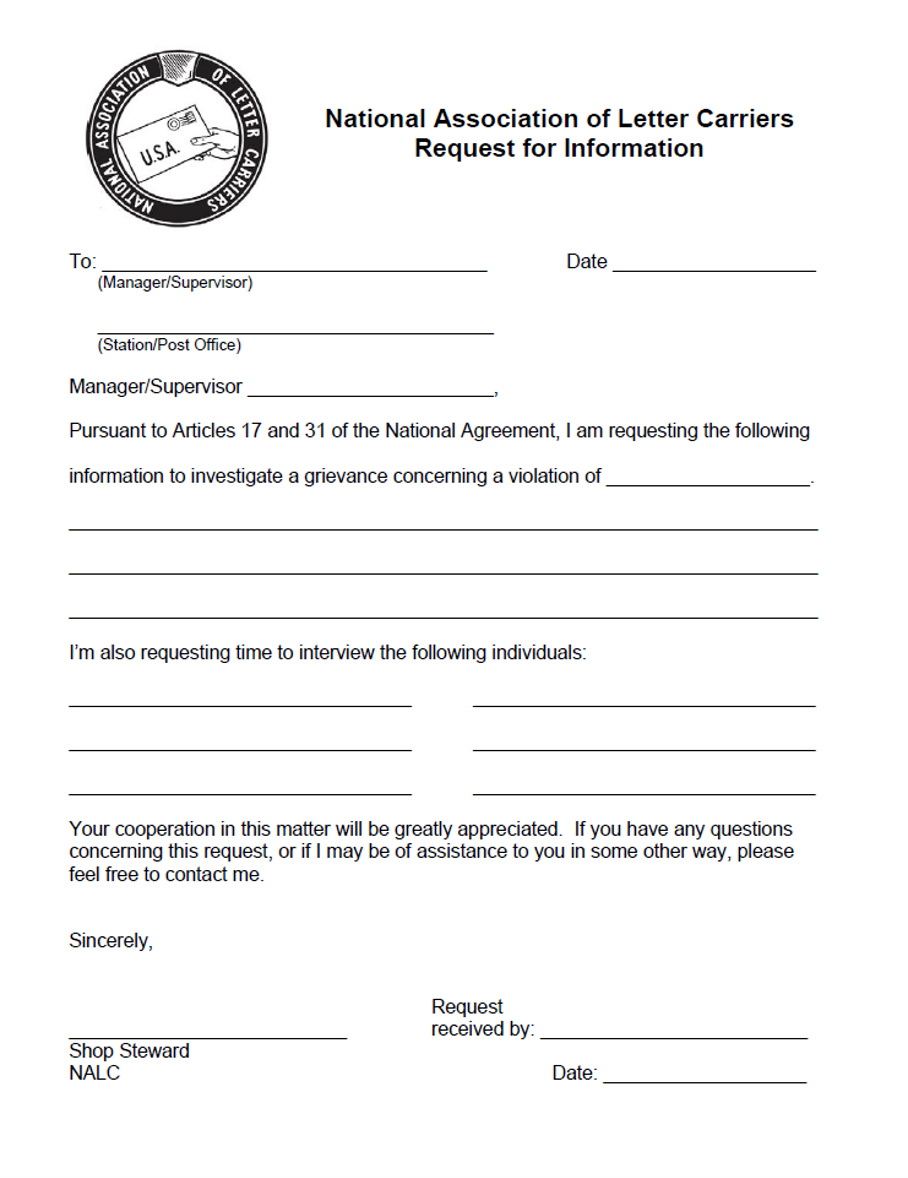
The difference between the forms is the sample information request form for discipline cases contains the general catch-all request for “any and all documents, statements, records, reports, audio or video recordings, photographs, or other information learned, obtained, developed or relied upon by the Postal Service” when it issued the discipline.
You should include this language in every information request in discipline cases since you will not necessarily know every piece of information management had or relied upon when it made the decision to issue the discipline. Even in circumstances where your request includes this “catch all” language, nothing precludes you from also including requests for specific information if you believe it exists. For example, you might know there is a police report relevant to your investigation. In that case you should ask for a copy of the police report in your information request. As the JCAM explanation of Article 31, Section 3 (shown at the beginning of this section) states, “To obtain employer information the union need only give a reasonable description of what it needs…” In this example, it is reasonable to tell management you need the police report as part of your investigation into the discipline case. This subject will be further explained later in the section.
Prepare your requests in duplicate. Sign and date both copies and have the receiving supervisor sign and date one of the copies for you to take for your records. Always keep a copy with both signatures in the grievance file. It will be a permanent record of what you requested, when you requested it, and to whom the request was made. This will be extremely helpful if management fails to provide any of the properly requested information. If management refuses to sign for your request, make sure you document the date and time of the request and provide a witness statement if anyone saw the request being made. This is an important step, so don’t forget it.
Article 17, Section 3 of the National Agreement further states that stewards have a right to information using the following language:
The steward, chief steward or other Union representative properly certified in accordance with Section 2 above may request and shall obtain access through the appropriate supervisor to review the documents, files and other records necessary for processing a grievance or determining if a grievance exists and shall have the right to interview the aggrieved employee(s), supervisors and witnesses during working hours. Such requests shall not be unreasonably denied.
Remember that your information requests are not limited to copies of documents, you can review them too. You can also request to interview anyone involved in the matter you are investigating in order to find out what they heard or saw and have them write a statement to add to the grievance file. This is another way to gather the information needed to be successful in the grievance procedure. Just include the request for the interview on your information request.
You should always submit an information request as soon as possible after you become aware of the need to investigate a particular matter. Management is required to provide the requested information and time on the clock to conduct requested interviews within a reasonable time period after receiving an information request. What is a reasonable time period can vary depending on the type and amount of information or number of interviews you request for a particular grievance. However, generally speaking, if the grievance procedure is working as it was intended, most information or interview requests should be fulfilled by management within a few working days of when your request is received. Remember to keep a copy of your information or interview request showing who received your request and the date it was received.
As stated above, if the supervisor refuses to sign your request, document the refusal. Write “refused to sign,” the date, and initial the request where the supervisor would normally sign. If anyone witnessed the refusal, this would be a good time to submit a written request to interview the witness. When the interview is granted, have the witness print and sign their name with the date they signed the form, and ask each witness for a written statement. This will provide the best evidence of the refusal.
Another problem that you may encounter is when management receives your information request, but doesn’t provide what you requested. In either case, it boils down to a refusal to provide properly requested information. If you run into either one of these problems, don’t panic. Just follow four simple steps:
- Keep the request form with your grievance file as it is now evidence of the refusal and part of your case.
- Add a second issue statement to your case (on a separate sheet of paper if at Informal Step A) to address the violation of Articles 17 and 31 of the National Agreement.
- Process your grievance within the time limits without the requested information.
- Be sure to document and explain your attempts to obtain the requested information in your
case file and point out what the information would have shown had it been provided by submitting
a steward or Formal Step A representative statement to include in the case file being
appealed to the next step of the DRP.
If this becomes a repetitive problem, continue to frame an additional issue in each case as advised above to address the violation and take two additional steps: - Request additional remedies to provide an incentive for future compliance (see the Remedies section on page 101 in this guide).
- Contact branch officers or your branch president as appropriate and report the repetitive problem.
Always remember that the failure on management’s part to provide requested information or grant requested interviews does not change the time limits for initiating grievances at Informal Step A or appealing grievances to any other step of the grievance procedure.
You should also let management know how much time you think you will need to complete your investigation to determine whether or not a grievance exists. Remind them that you will need time to complete your investigation prior to the Informal Step A meeting and that the meeting must be held by a certain date in order to meet the 14 calendar day time limit.
The explanation of Article 17, Section 3 on page 17-6 of the 2014 JCAM states in part:
Steward requests to review and obtain documents should state how the request is relevant to the handling of a grievance or potential grievance. Management should respond to questions and to requests for documents in a cooperative and timely manner. When a relevant request is made, management should provide for review and/or produce the requested documentation as soon as is reasonably possible.
You must have a valid reason whenever you request information from management. Your request to review and obtain documents should state how the request is relevant to the investigation or processing of a grievance. You do not have to lay your entire case out in a request. However, the union should give a reasonable description of what is needed and make the claim it is needed to enforce the contract.
For instance, if questioned as to the relevance of an information request, you might say you are investigating an alleged overtime or route inspection violation, improper disciplinary action, etc. That should be enough to justify requesting documents or interviews related to the matter.
Keep in mind that just because you requested information from management does not mean you must file a grievance. You may determine through your investigation that a grievance doesn’t exist. If this happens, be sure to go back to the grievant as soon as possible and tell him or her there is no grievance and explain why.
If after reviewing the information received you determine additional information is needed, put in another request. There is nothing stopping you from making additional requests for the same grievance. Make this additional request as soon as you realize more information is needed. Just remember, the original 14 calendar day time limit to meet at Informal Step A still applies.
In most cases it is understood that you would like copies of the information you are requesting. If copies are requested, the USPS must provide them. One thing to consider when making your requests is there may be a cost to the union associated with the request. The fees which management may charge the NALC for providing information are governed by Handbook AS-353 [Guide to Privacy and Freedom of Information Act] Section 4-6.5. Currently AS-353, Section 4-6.5 provides for a waiver of information fees for:
- The first two hours of manual search time
- The first two hours of computer search time
- The first 100 pages of duplication, $0.15 per page thereafter (The Postal Service should not charge the union for fees that do not exceed $10.00 after the first 100 page waiver- AS-353, Section 3-4.4)
The principles referenced above over computer search fees which management may charge the NALC were further reinforced in M-01698. This agreement also provides that the Postal Service will not charge the union at a higher computer usage rate to produce copies of documents.
The information you request will frequently be available in digital format. If you know you will need a large amount of information and the Postal Service is going to charge you for hard copies, ask them to send the information to you electronically and print it out yourself. You could also try to use some type of removable media (flash drive, CDR, DVDR, etc). Make sure to check with your Formal Step A representative or branch president to be sure they will be able to view your electronic documentation if you are unable to resolve the grievance at your level.
Another way to handle a situation where there will be a charge for copies is to request to review the information you are looking for. Reviewing information can sometimes reduce the number of pages of information you need copies of to document the contract violation in your grievance file. Remember, you have a right to information needed to investigate a possible grievance. Do not let management off the hook simply because they threaten to charge you for the information. Information requests by the union should be fulfilled by management. You should consult your branch officers if you have any questions about management charging fees for information.
The National Agreement is clear that grievances are to be settled at the lowest possible level. To get the clearest picture of the case and have the best chance of settling the dispute, it is important to have all the information at hand. Do not leave it up to the next person who handles the grievance to ask for information that is needed to prove the union’s case.
Management’s right to deny information is extremely limited. Relevant information properly requested by the union must be provided. Refusals for reasons such as “the union could get the same information from its members, the request is too large, the grievance has no merit, the grievance is not arbitrable, or the materials are privileged” are in violation of Article 31 of the National Agreement and should be grieved. This is where the copy of your information request will come in handy. It will serve as your evidence of the request.
The Privacy Act
Sometimes management refuses to provide requested information to the union claiming that the Privacy Act bars the USPS from disclosing medical records or other confidential information. Managers often tell NALC representatives they will not release personal information without the written consent of the affected person. These management excuses are flatly wrong because the Privacy Act’s regulations authorize disclosure to the union of most records containing personal information. The Privacy Act does require federal agencies to restrict access to certain records that contain information about individuals, but the AS-353 [Guide to Privacy, the Freedom of Information Act and Records Management] makes it clear that providing information to the union falls within the “routine” use category, and is, therefore, an authorized disclosure under the Privacy Act.
See also the article on "Steward's Right to Information” in the Fall 2011 NALC Activist.
Investigatory Interviews +
One of the most important yet least understood roles of a shop steward is representing letter carriers in investigatory interviews.
Investigatory interviews are also called many other names, such as an I.I., pre-disciplinary interview (PDI), fact-finding interview, etc. These terms are interchangeable and all mean the same thing. They are referring to a required meeting between an individual letter carrier and a management representative, USPS Office of Inspector General (OIG) agent, or USPS Postal Inspector. While agents and inspectors may be involved in these interviews, management has an obligation to conduct their own independent investigation. This type of meeting usually occurs when management is considering issuing discipline to the letter carrier being interviewed.
Management is required by the contract and federal law to allow a letter carrier the opportunity to hear and answer any allegations that could lead to disciplinary action being taken against him or her prior to any notice of discipline being issued by management. A narrow exception to this rule would be when a letter carrier is placed on an “Emergency Suspension” pursuant to Article 16, Section 7 of the National Agreement.
These interviews can be conducted by managers, Postal Inspectors, or OIG agents. It is important for you to understand the rights of both the employee and the union in these situations. It is also critical that you have an understanding of the different types of warnings a postal inspector or an OIG agent may issue an employee when an investigatory interview crosses over into the realm of a possible criminal investigation. We will discuss those later in this section.
Most of the time, investigatory interviews do not involve a criminal situation. They normally involve management suggesting that a letter carrier violated a rule or regulation. As a steward, you have certain rights with respect to representing those letter carriers who find themselves in this type of situation. The following is an explanation of the rights afforded to the letter carrier and their shop steward.
Weingarten Rights
The “Weingarten” rule gives employees the right to representation during investigatory interviews. Arbitrators almost universally find that a violation of Weingarten rights is an extremely serious matter. It not only tramples on an employee's individual rights, but also undermines the union's ability to exercise its representation responsibilities.
How do these rights play out in a real life situation? What do you do when management approaches you about a letter carrier whom they claim was driving with her door open and no seat belt on and they want to speak with her? What if a letter carrier calls you on the phone and tells you that management conducted a pre-disciplinary interview with him regarding the late delivery of an express mail piece even though he asked to have a shop steward present? Any of these scenarios could happen in your office and there are things you as a steward can do to effectively handle each one.
Let’s use the example of management initiating an interview with a letter carrier whom they state was driving with her door open and with no seat belt on. If management approaches you as the steward, they probably intend to abide by her Weingarten rights and have you present at the interview. However, there may be times where this isn’t the case. Some managers or supervisors will not even speak with the steward, but will just call the letter carrier into the office and start questioning him or her.
Unlike Miranda rights (explained later in this section), Weingarten does not require that a mandatory explanation of these rights be given to a letter carrier before the interview. Unless the letter carrier asks for union representation, the interview proceeds. You as a steward cannot invoke a letter carrier’s Weingarten rights for him or her. Letter carriers must know to ask for representation on their own.
Letter carriers may invoke their Weingarten rights and ask for union representation whenever they reasonably believe that a discussion with, or questioning by, management may lead to discipline. Letter carriers may invoke their Weingarten rights and ask for union representation whenever they reasonably believe that a discussion with, or questioning by, management may lead to discipline. It’s up to the letter carrier to make that determination and ask for representation.>
The meeting between the letter carrier and management does not have to be formally called an “investigative interview” or another term meaning the same thing. If the letter carrier has a reasonable belief that discipline could result from any conversation with management, he or she is entitled to union representation.
It is important for stewards and branch officers to educate their branch members of these critical rights afforded to them under Weingarten. Small cards designed to serve as a reminder of these rights are available from the NALC Supply Department. Additionally, many branches have made small laminated cards for members. An example of such a reminder could read something like this:
If called to a meeting with management, Postal Inspectors, or an OIG agent, read the following before the meeting starts:
“If this discussion could in any way lead to my being disciplined or terminated, or affect my personal working conditions, I respectfully request that my union representative, officer, or steward be present at this meeting. Without my Union representation present, I respectfully choose not to answer any questions or participate in this discussion.”
Once a letter carrier asks for representation, management is required to provide him or her with a steward. If management fails to provide the representation, management has committed a violation of the letter carrier’s Weingarten rights. This is a serious due process violation.
When discipline is issued after a Weingarten rights violation, you should write or frame an additional issue to raise this serious violation of the letter carrier’s due process rights in any grievance protesting the discipline that was issued. When you raise this issue in a grievance, remember to explain the circumstances in the union’s disputed facts and contentions (block 17 on PS Form 8190) and request an appropriate remedy for the Weingarten rights violation in addition to the remedy you would normally ask for in a discipline case. For example, you could ask for management to cease and desist from future Weingarten rights violations in addition to requesting that the discipline issued be rescinded, expunged from all employee records and files, and the letter carrier involved be made whole.
Let’s go back to the letter carrier who is accused of driving with her door open and not wearing a seat belt. If the letter carrier invoked her Weingarten rights, you as a steward and the grievant have a right to know the purpose of the investigative interview before it begins. Additionally, you as a steward have the right to speak with the grievant alone after you know what the interview is going to be about and before it begins.
Once the interview begins, you as a steward are not just a silent party or witness to the interview. You have a right to participate in the interview. For example, you can ask questions if you have any or ask to take a break and speak with the letter carrier. Keep notes during the interview including the questions management asks and the responses given by the letter carrier. You should also note any comments, questions, or objections you raised as well as any response from management or the letter carrier.
It is also important that you request a copy of management’s notes as part of any grievance investigation related to the interview. The union has the right to request these notes through Articles 17 and 31 of the National Agreement. These notes may be helpful when investigating a potential grievance.
The Weingarten rights of letter carriers have been tried and tested throughout the years. This has resulted in numerous pre-arbitration and Step 4 (national-level) agreements along with many regional arbitration decisions. What follows is the JCAM language provided in Article 17 of the National Agreement. At the end of this section you will find a sampling of the resulting grievance resolutions.
Page 17-6 of the 2014 JCAM provides the following explanation of Weingarten rights:
Weingarten Rights Federal labor law, in what is known as the Weingarten rule, gives each employee the right to representation during any investigatory interview which he or she reasonably believes may lead to discipline. (NLRB v. J. Weingarten, U.S. Supreme Court, 1975) (M-01789)
The Weingarten rule does not apply to other types of meetings, such as:
- Discussions. Article 16.2 provides that “for minor offenses by an employee ... discussions ... shall be held in private between the employee and the supervisor. Such discussions are not discipline and are not grievable.” So an employee does not have Weingarten representation rights during an official discussion (National Arbitrator Aaron, H1T-1E-C 6521, January 6, 1983, C-03769).
- Employees do not have the right to union representation during fitness-for-duty physical examinations.
The Weingarten rule applies only when the meeting is an investigatory interview— when management is searching for facts and trying to determine the employee’s guilt or decide whether or not to impose discipline. The rule does not apply when management calls in a carrier for the purpose of issuing disciplinary action—for example, handing the carrier a letter of warning.
An employee has Weingarten representation rights only where he or she reasonably believes that discipline could result from the investigatory interview. Whether or not an employee’s belief is “reasonable” depends on the circumstances of each case. Some cases are obvious, such as when a supervisor asks an employee whether he discarded deliverable mail.
The steward cannot exercise Weingarten rights on the employee’s behalf. And unlike “Miranda rights,” which involve criminal investigations, the employer is not required to inform the employee of the Weingarten right to representation.
Employees also have the right under Weingarten to a pre-interview consultation with a steward. Federal Courts have extended this right to pre-meeting consultations to cover Inspection Service interrogations. (U.S. Postal Service v. NLRB, D.C. Cir. 1992, M-01092).
In a Weingarten interview the employee has the right to a steward’s assistance—not just a silent presence. The employer would violate the employee’s Weingarten rights if it refused to allow the representative to speak or tried to restrict the steward to the role of a passive observer.
Although the ELM Section 665.3 requires all postal employees to cooperate with postal investigations, the carrier still has the right under Weingarten to have a steward present before answering questions in this situation. The carrier may respond that he or she will answer questions once a steward is provided.
It should be noted that Article 17, Section 3 also provides:
If an employee requests a steward or Union representative to be present during the course of an interrogation by the Inspection Service, such request will be granted. All polygraph tests will continue to be on a voluntary basis.
Note: This rule is generally less broad in scope than the Weingarten rule since it applies only to “interrogation by the Inspection Service,” whereas the Weingarten rule applies to investigatory interviews by any supervisor or management representative. Nevertheless, it should be cited in addition to the Weingarten rule whenever it is violated by management and Postal Inspectors are involved.
An important point that bears repeating is that stewards cannot exercise Weingarten rights for a letter carrier. A letter carrier must ask for a steward to be provided before being questioned. This is an important distinction between Weingarten rights and a Miranda warning.
Miranda Warnings
The most common and well-known warning is a Miranda warning. Most people are familiar with this warning from watching television. The Miranda warning is:
“You have the right to remain silent. Anything you say can and will be used against you in a court of law. You have the right to have an attorney present before any questioning. If you cannot afford an attorney, one will be appointed to represent you before any questioning.”
Miranda warnings should not be confused with Weingarten rights. They derive from the landmark U.S. Supreme Court decision in Miranda v. Arizona, 384 U.S. 436 (1966) which concerned constitutional rights prior to an interrogation in criminal cases.
It is critical for stewards to understand and recognize the difference between a normal investigatory interview and investigations that cross the threshold into criminal investigations. Postal Inspectors or other law enforcement officials cross the threshold into a criminal investigation when they read employees their Miranda rights. Once the warning is given, anything the letter carrier says can be used against him or her in a court of law.
A criminal investigation is underway when Postal Inspectors or OIG agents request that the employee sign any form that would waive their Miranda rights such as PS Form 1067, United States Postal Inspection Service Warning and Waiver of Rights. Stewards should always advise letter carriers not to sign any form that would waive their Miranda rights. If an employee does sign a form to waive their Miranda rights, anything the employee says from that point forward can be used against the employee in a court of law.
Stewards should also remember that they are not attorneys and thus cannot offer legal advice to employees facing potential criminal charges. Stewards should immediately inform the employee that he or she may wish to seek legal advice should there be any possibility that the Postal Service will bring criminal charges against the employee. You should also advise the letter carrier not to answer any questions Postal Inspectors ask and that the interrogation should be suspended until the employee has had an opportunity to consult with an attorney.
When you are dealing with an issue that concerns both criminal law and the contract, here is the problem that you run into; ELM Section 665.3 requires all postal employees to cooperate with postal investigations. Miranda rights say that anything you say can be used against you in a court of law. This would appear to put the employee in an impossible position. Should an employee answer questions even if the answers may result in criminal charges, or should the employee refuse to answer questions risking the possibility of discipline for "failure to cooperate" in an investigation?
This problem was resolved by the federal courts in Edward Garrity v. New Jersey (385 U.S. 493) January 16, 1967 and George Kalkines v. the United States (473 F.2d 1391 Fed. Cir.) February 16, 1973, amended June 1, 1973.
Kalkines Warnings
The Kalkines warning requires employees to make statements and cooperate even if it could lead to being disciplined or discharged, but provides criminal immunity for their statements. A Kalkines warning could read something like this (the exact wording may vary):
“You are being questioned as part of an internal and/or administrative investigation. You will be asked a number of specific questions concerning your official duties, and you must answer these questions to the best of your ability. Failure to answer completely and truthfully may result in disciplinary action, including dismissal. Your answers and any information derived from them may be used against you in administrative proceedings. However, neither your answers nor any information derived from them may be used against you in criminal proceedings, except if you knowingly and willfully make false statements.”
This warning means the letter carrier must be truthful, but can do so without their answers being used against them in a criminal proceeding.
Garrity Warnings
A Garrity warning advises suspects of their criminal and administrative liability for any statements made, but also advises suspects of their right to remain silent on any issues which may implicate them in a crime. A Garrity warning could read something like this (again the exact wording may vary):
You are being asked to provide information as part of an internal and/or administrative investigation. This is a voluntary interview and you do not have to answer questions if your answers would tend to implicate you in a crime. No disciplinary action will be taken against you solely for refusing to answer questions. However, the evidentiary value of your silence may be considered in administrative proceedings as part of the facts surrounding your case. Any statement you do choose to provide may be used as evidence in criminal and/or administrative proceedings.”
The Garrity warning helps to ensure a suspect's constitutional rights. It also allows federal agents to use statements provided by suspects in both administrative and criminal investigations. If a letter carrier is given a Garrity warning, shop stewards should always advise the letter carrier to consult with an attorney before answering any questions.
It is important you understand these rights and warnings so you are better prepared to represent letter carriers and to educate them on their rights during an investigatory interview.
Just remember these two things:
- A letter carrier is always entitled to representation by the NALC when he or she has a reasonable belief that discipline could result from the conversation. This is true whether you have a Weingarten, Miranda, Kalkines, or Garrity situation.
- You are not a lawyer. If the matter being investigated is a criminal matter, advise the letter carrier to consult with a lawyer.
National Level Awards, Settlements
The following decisions will give you a better understanding of these topics and will give you some ideas to support any potential grievances that may arise regarding investigatory interviews and rights that letter carriers have during them.
- M-01092 USPS v NLRB, No. 91-1373 D.C. Cir, June 30, 1992 Decision by the U.S. Court of Appeals for the D.C. Circuit upholding an NLRB decision concerning Weingarten rights (M-01093). The Board held that Postal Inspectors violated the Weingarten doctrine by refusing a request by a steward to consult with an employee prior to the employee's interrogation by the Postal Inspectors.
- M-01668 NLRB Decision December 28, 2007, Case 25–CA–29340 National Labor Relations Board decision finding that a supervisor conducting an investigatory interview improperly prevented a steward from speaking when the steward sought to object to a "loaded" question asked of the letter carrier being interrogated.
- M-00546 NALC Legal Memorandum November 30, 1981 Recent decisions of the National Labor Relations Board and the United States Court of Appeals for the Ninth Circuit established that: (1) when an employee being interviewed by an employer is confronted by a reasonable risk that discipline would be imposed, the employee has a right to the assistance of—not mere presence of—a union representative; and (2) that an employer violates the Act when it "refuses to permit the representative to speak, and relegates him to the role of a passive observer.”
- M-00645 Step 4 July 19, 1977, NC-S-4767 Supervisors may have work related discussions with employees under their jurisdiction without a steward's presence. However, in this specific instance, the supervisor wanted a witness present. This unusual action justifiably caused concern by the employee and as a consequence his request to have a steward present was not unreasonable.
- M-01096 Prearbitration Settlement September 16, 1992, H7N-5N-C 31554 The parties at this level agree that under the Weingarten rule, the employer must provide a union representative to the employee during the course of its investigatory meeting where the employee requests such representation and the employee has a reasonable belief that discussions during the meeting might lead to discipline (against the employee himself). Whether or not an employee reasonably believes that discipline will result from the investigatory interview is a factual dispute and is suitable for regional determination. See also M-00436
Arbitration Case Examples—Weingarten Rights
- C-15476 Regional Arbitrator DiLauro June 12, 1998
“The reason rights have been established under the Weingarten case or under
5U.S.C.§7114 are to protect any employees from stating or agreeing to something in an investigatory
interview which could incriminate them and result in disciplinary action against
them. Therefore, once union representation is requested and granted, all questioning should
cease until such representation arrives.”
“The Postal Service’s reliance on statements allegedly made during the Postal Inspector’s interview with the grievant is the ‘evidence’ the Postal Service points to as proving the grievant was guilty. The fact that such ‘evidence’ has been found to be tainted due to the Postal Inspector’s questioning of the grievant when union representatives were not present makes the evidence producing the chain of circumstances pointing to guilt weak and inconclusive and no probability of fact may be inferred from the combined circumstances. [South Penn Oil Co., 29LA718 (Hebert, 1957)] Consequently, the grievance must be sustained.” - C-10291 Regional Arbitrator Barker September 26, 1990 “In the factual circumstances of this case, a valid request was made by the grievant to Sutton for representation by a steward during the course of the imminent investigatory meeting with the Postal Inspectors, which request was not granted…. Accordingly, the grievant was denied fundamental procedural due process rights and the disciplinary action imposed was not for just cause.”
- C-09556 Regional Arbitrator Olson November 30, 1989
“I conclude the interview of the grievant by management during the meeting on January 12,
1989 was investigatory and of the nature that it might reasonably result in discipline. The
grievant requested union representation during this interview and that request was denied by
management. This request sufficed for the entire interview which included the questioning of
the grievant regarding the vandalism incident, the inspection of the contents of her locker,
and the questioning of her regarding the four pieces of mail discovered in her locker. Management,
in denying the grievant’s request for union representation, violated her Weingarten
rights, and therefore her removal was flawed.”
“Accordingly, I conclude that the Postal Service did not have just cause to remove the grievant. Recognizing, however, the gravity of the offense which the grievant committed, her reinstatement shall not include back pay.” - C-20955 Regional Arbitrator Goldstein August 14, 2000
“Here was a case that cried out for Removal; except that both the grievant’s rights to due
process and union’s rights of representation were trampled, not just stepped upon. To begin
with, the Employer’s entire case rested upon the efforts of the Postal Inspector’s Investigative
Memoranda, yet, he was unavailable for testimony. In addition to the fact that all allegations
regarding the altered document were hearsay; there were instances of ‘Weingarten’
type abuse, as well. Aside from testimony of the shop steward and grievant, it was the testimony
of the former Postmaster which convinced me that union representation in his office
was far less than anticipated. The evidence was clear and convincing that the union steward
was, in effect, prohibited from any form of representation during at least one disciplinary
meeting before the then Postmaster of grievant’s facility.”
“In conclusion, management did have reasonable basis to severely discipline this employee for her behavior generally, in regard to unsatisfactory conduct surrounding her request for injury related leave; including her action in delivering an altered document in support of that leave. The evidence in support of the charges was clear.”
“However, the handling of this matter was marked by serious procedural error; which like the grievant’s judgment, cannot be condoned either. For that reason, the Removal must be converted to a long term suspension, without back pay.” - C-24014 Regional Arbitrator Johnston January 31, 2003
“There was at the arbitration hearing a conflict between Postal Inspector Smith’s version of
what happened at these two meetings with Ms. McRae and Ms. McRae’s version of what
happened at those two meetings. However, a reading of paragraph 8 of the Investigative
Memorandum shows that Ms. McRae was not permitted to have a union representative present.
She was accompanied by another Postal employee Rural carrier Sue Alsop, but Ms.
Alsop is not a union official. Therefore, her due process rights, also known as the Weingarten
rights, were improperly denied her by Postal Inspector Smith.”
“Having found that the Postal Service violated the Grievant’s due process rights as set out above, it is incumbent on me due to this lack of procedural due process, that the disciplinary action taken by the Postal Service cannot be upheld. My AWARD will set out the action to be taken due to this failure of procedural due process.”
“Had the Postal Service not violated her due process rights to such an extent as to cause the reversal of their decision to discharge the Grievant, or in other words, had I reached the merits of this case, I would have sustained the Postal Service’s action in terminating the employment of the Grievant.” - C-24702 Regional Arbitrator Nixon October 2, 2003
“The Postal Service notes that the Service did not deny the right, but by an independent and
separate entity, the United States Postal Inspectors. The United States Postal Inspectors
are not under the jurisdiction of any authority of the United States Postal Service. As such,
these inspectors were not ‘employers’ as contemplated by the Weingarten requirements.
Even if Weingarten required the United States Postal Service to permit carrier Perkins to
speak with his union representative, the United States Postal Inspectors were not.”
“The Arbitrator finds this distinction forced and inaccurate.”
“While the Postal Inspectors are a separate entity, at the time of November 13, 2002 investigations, they were gathering information that could be potentially, and in fact was used in a discipline of the Grievant. They were standing in the shoes of the employer. As such, they must be willing to follow all safeguards that would apply to the employer. Those safeguards included permitting the Grievant to meet privately with the union representative. The Postal Inspectors were clearly acting in part for the United States Postal Service. The information gathered was used by the United State Postal Service and other agencies. Because they were standing in the shoes of the Agency, they must follow the procedures employed by the Agency. The Postal Inspectors failed to do so in a critical respect. For that reason, the discipline cannot stand.”
“Because of the actions of the Postal Inspectors in the conduction of the investigation, the claim of procedural due process has sufficient merit to be sustained. Accordingly, the Arbitrator will sustain the grievance.” - C-27659 Regional Arbitrator Roberts June 19, 2008 The grievant’s rights were violated when he was not allowed to consult with his representative prior to a pre-disciplinary interview. Removal action must be reversed and the grievant made whole.
- C-27768 Regional Arbitrator Bahakel September 4, 2008 “The National Agreement between the parties reserves to an employee the right to a pre-interview consultation with a union steward and the right to have a union steward present at an investigative interview. Denying the Grievant these rights is clearly a violation of the contract between the parties as well as a violation of the Grievant's Weingarten rights. Management's actions prejudice the Grievant by denying him the right to consult with a union steward as to his rights before being questioned by management. Once a Grievant's request to confer with a steward about his rights is denied, and an investigative interview is improperly held, the moment has passed where the Grievant's rights can be restored simply by holding another interview in accordance with the proscribed procedures. Therefore, when management has conducted an investigative interview after denying the Grievant his right to a union steward, it cannot ‘heal’ or correct its actions by simply holding another interview with a union representative present.”
- C-28422 Regional Arbitrator Cenci September 3, 2009 “…denial of the grievant's Weingarten rights during the investigatory interview conducted by the OIG was not rendered harmless by a later PDI in which the grievant admitted to the conduct while represented by a steward. The investigation was fatally flawed when the grievant was not afforded his contractual rights during the investigatory interview conducted by the OIG. That meeting was the first time the grievant was questioned about his employment application and the denial of his rights at that stage could not be subsequently corrected. Management did not have just cause to issue the Notice of Removal dated April 16, 2009 because the investigation was fatally flawed by the denial of the grievant's Weingarten right to be represented by a union steward at an investigatory interview that could lead to discipline. The grievant is to be reinstated and made whole for all losses he incurred as a result of the removal.”
Supporting Cases—Weingarten Rights
- C-09556 Regional Arbitrator Olson, Nov. 30, 1989
- C-10291 Regional Arbitrator Barker, Sep.26, 1990
- C-14117 Regional Arbitrator Shea, Nov. 30, 1994
- C-15476 Regional Arbitrator DiLauro, June 12, 1998
- C-20955 Regional Arbitrator Goldstein, Aug. 14, 2000
- C-24014 Regional Arbitrator Johnston, Jan. 31, 2003
- C-24702 Regional Arbitrator Nixon, Oct. 2, 2003
- C-27659 Regional Arbitrator Roberts, June 19, 2008
- C-27768 Regional Arbitrator Bahakel, Sept. 4, 2008
- C-28422 Regional Arbitrator Cenci, Sept. 3, 2009
Tips for Writing Statements +
Written statements are extremely important in our dispute resolution process. This is especially true if the grievance is appealed to Step B. The Step B team will render a decision based on what is contained in the case file. The quality of the statements in the file can be the difference between success and failure in the grievance procedure.
A statement in a file serves as a snapshot of what happened in a particular event. It is up to the steward to ensure that the picture shown through the statements in each case file is clear and accurate. A grievance file may contain statements from a number of different people. The grievant should normally write a statement for the file and witness statements are often needed.
If you are a steward, you should also consider writing a steward statement to describe what happened at Informal Step A to include in the file as the grievance moves forward. Steward statements should explain the case completely so someone unfamiliar with the situation can fully understand it. Do not leave it up to the next person to try to piece the puzzle together.
Some statements are more effective than others. In this section, we will discuss a few easy-to-remember tips for writing an effective statement for a grievance file.
- Effective statements are clearly written and contain specific details about what was seen or heard. The best statements are usually written as soon as possible after an event occurs.
- If you write a statement, ask someone else to proofread it before you include it in the grievance
file. An effective statement will contain thorough answers to as many of the following
questions as possible:
- Who was involved?
- What happened?
- Exactly what did you see and hear?
- When did the event occur (date and time)?
- Where did the event occur?
- Exactly where were you when the event happened?
The best statements stay focused on answering the questions above with detailed facts and normally avoid expressing personal opinion. The reader should be able to get a clear picture of what happened.
Here are two examples of a statement from a grievant describing the same event. The event is an allegation of supervisor misconduct on the workroom floor.
Grievant Statement #1:
I asked for a 3996 today and Supervisor X got in my face and harassed and intimidated me again. He has treated me like this for a long time. I am sick of it. I shouldn’t have to put up with
treatment like this. Supervisor X always singles me out and treats me unfairly. He gets so angry that I feel threatened all the time. I can’t take it anymore. I am a nervous wreck. This has to stop or I don’t know what I’ll do.
Grievant Statement: #2:
I asked Supervisor X for a 3996 today (8-30-13) at 9 AM while I was casing my route. When I asked him for a 3996 he became very angry and started raising his voice screaming that I didn’t need a 3996. He got up from his desk which is about 30 feet from my case and rushed toward me. His fists were clenched and his face was red. He stepped into my case and came within three (3) inches of my face. He kept yelling that I did not need any help to complete my route and that I had enough undertime to take half an hour from another route. I thought he was going to physically attack me. This isn’t the first time he has behaved this way.
Consider the examples above. The first statement is full of the writer’s emotions and opinions and is very vague about exactly what happened. The second statement is much more descriptive and focuses on the facts rather than emotion.
Effective statements don’t take much more time or effort to write than ineffective statements. It’s just a matter of getting the person writing the statement on the right path. One way to do this is to ask the writer some questions to draw out the detailed facts of the event before he or she writes a statement.
After someone has written a statement, make sure you read it carefully. Ask yourself some questions such as:
- Does this statement help to prove the facts and contentions of my case?
- Does this statement run on without providing what information was needed to be addressed by the witness?
- Does the statement explain enough detail about the event it describes?
If the statement is ineffective or incomplete, either have the writer add to the statement or write a new one after asking some questions to draw out missing facts. You should consider not including a statement in the file that is ineffective or damaging to your case. This is a judgment call that you will sometimes have to make.
These are serious considerations you should make when evaluating statements you receive for a potential grievance. As you review statements, you should put yourself in the position of someone that doesn’t know a thing about the people or particular circumstances in your office. With this in mind, do the statements you have tell the story of the event so it can be easily understood without local knowledge?
In summary, make sure any statements you gather and submit are:
- Legible
- Sufficiently detailed
- Relevant and helpful to the grievance
- Signed (including the printed name [no nicknames], title, and contact information for the person writing the statement)
- Dated
Remedies +
Remedy requests are the bottom line of your efforts to represent letter carriers in the grievance procedure. Requesting appropriate remedies is one of the most important elements of a successful grievance. An inappropriate or insufficient remedy request for a contract violation in an otherwise well-written grievance can cause you to win the battle, but lose the war for obtaining justice for the letter carriers.
The appropriate remedy request will vary from case to case and grievant to grievant. The most important thing to remember is to balance not asking for too much with not asking for too little. This can be a difficult task. This section of the NALC Shop Steward’s Guide will help you understand the difference.
Remember from the previous sections that you should prepare each case as if it will be heard by an arbitrator. Having an understanding of what remedies an arbitrator can legally and contractually award is a good starting point to requesting appropriate remedies for contract violations.
There is a saying that goes like this: Without remedies there are no rights. National Arbitrator Richard Mittenthal eloquently restated this point when he wrote, “The grievance procedure is a system not only for adjudicating rights but for redressing wrongs." (C-03234) In his June 9, 1986 award C-06238, National Arbitrator Mittenthal explained the legal and contractual basis for remedies as follows:
One of the inherent powers of an arbitrator is to construct a remedy for a breach of a collective bargaining agreement. The U.S. Supreme Court recognized this reality in the Enterprise Wheel case:
“...When an arbitrator is commissioned to interpret and apply the collective bargaining agreement he is to bring his informed judgment to bear in order to reach a fair solution of a problem. This is especially true when it comes to formulating remedies. There the need is for flexibility in meeting a wide variety of situations. The draftsmen may never have thought of what specific remedy should be awarded to meet a particular contingency.” United Steelworkers of America v. Enterprise Wheel & Car Corp.
National Arbitrator Gamser also observed in his April 3, 1979 award as follows (C-03200):
“...to provide for an appropriate remedy for breaches of the terms of an agreement, even where no specific provision defining the nature of such remedy is to be found in the agreement, certainly is found within the inherent powers of the arbitrator.”
Generally, an appropriate remedy for a contract violation is to restore the grievant to the status quo. This means to return the grievant to the position they would have been in if the violation of the contract had not occurred. This is commonly referred to as “making the grievant whole.”
Below are two examples of a status quo (make whole) remedy request for a removal grievance.
Example # 1 is a remedy request for a grievant who was improperly removed, was not on the overtime desired list (OTDL) at the time of his removal, and had no plans to get on the OTDL in a future quarter while he was out on removal:
a. Expunge the Notice of Removal dated ______, charging the grievant with _________________, and remove it from all employee records and files.
b. Make the grievant whole for all wages and benefits lost as a result of this action, to include interest at the federal judgment rate, or whatever remedies the Step B team or an arbitrator deems appropriate.
Example # 2 is a remedy request for a grievant who was improperly removed and was on the OTDL at the time of her removal or had plans to get on the OTDL in a future quarter while she was out on removal:
a. Expunge the Notice of Removal dated ______, charging the grievant with _________________, and remove it from all employee records and files.
b. Make the grievant whole for all wages and benefits lost as a result of this action, to include average overtime worked by letter carriers on the OTDL and interest at the federal judgment rate, or whatever remedies the Step B team or an arbitrator deems appropriate.
As you can see, the appropriate status quo (make whole) remedy request can vary depending on the particular circumstances of the grievant. This is true even when you are filing the same type of grievance for two different letter carriers.
It is always a good idea to use the catch phrase “or whatever remedy the Step B team or an arbitrator deems appropriate” as shown at the end of the example remedy requests above. You should do this for every grievance you file. This gives the union a better opportunity to adjust the remedy requested in a case at the later steps of the grievance procedure, if needed.
You may be wondering why requesting interest at the federal judgment rate is part of a status quo (make whole) remedy request. The reason is that you are preparing each grievance as if it will be heard by an arbitrator. If you are preparing a removal grievance to be heard by an arbitrator, the Memorandum of Understanding Re: Interest on Back Pay (discussed on page 16-4 of the 2014 JCAM) would apply. It states:
Where an arbitration award specifies that an employee is entitled to back pay in a case involving disciplinary suspension or removal, the Employer shall pay interest on such back pay at the Federal Judgment Rate. This shall apply to cases heard in arbitration after the effective date of the 1990 Agreement.The parties don’t always agree on what a make whole remedy entails.
An example would be an Article 8 grievance where a full-time employee not on the OTDL was required to work overtime instead of giving the overtime to a letter carrier on the list that was available to perform the work. The NALC position is that both the OTDL letter carrier who should have been given the work and the non-OTDL letter carrier who was improperly forced to work overtime were harmed, and therefore, both are due a remedy.
Management officials normally accept the notion that the letter carrier who should have worked the overtime was harmed, and thus, should be paid at the appropriate rate for the overtime hours they would have worked if it had not been for the contract violation. However, they don’t always accept our position that the non-OTDL letter carrier who was forced to work overtime was harmed.
Management representatives often resist giving a remedy to the non-OTDL carrier who was forced to work the overtime. When this happens, they argue that the letter carrier who was improperly forced to work overtime was not harmed since he or she was fully compensated for the extra work at the contractual overtime rate.
The NALC position is that the harm to the letter carrier who was improperly forced to work the overtime was a loss of their time for personal business, family time, and recreation. Overtime desired lists are in place not only for letter carriers who want to work overtime, but also for the protection of those who do not.
The ultimate remedy achieved in almost any type of grievance can vary and is normally dependent on a combination of the particular fact circumstances involved, the quality of the case file, and history of the violation. It is also true that different arbitrators grant different remedies for the same contract violations based on the same three factors when grievances are heard in arbitration.
All too often, NALC stewards are successful in proving that management violated the contract, yet are unsuccessful in obtaining a remedy that makes the grievant whole. This can happen because stewards sometimes forget that remedies are not automatic once a violation is established. Rather, the union should demonstrate that the remedy request is appropriate through documentation and arguments in each case.
There are two main goals every steward should focus on when deciding what to request as a remedy:
- Stop the violation from occurring in the future.
- Make the grievant whole.
The following are some ideas to help formulate appropriate remedies so you can be successful in obtaining justice for our brother and sister letter carriers.
Lump Sum Remedies
In your remedy request, you might want to ask for a lump sum remedy for a certain amount of money rather than asking for a specific amount of hours for letter carriers. Why? Management can process lump sum payments in GATS in less time than adjusting employee hours for payment. You can also request a lump sum remedy for a violation when there is not a monetary remedy to ask for that requires work hours to be paid.
Here are two examples of ways you can use lump sum remedies for certain issues:
Example 1: Sam the letter carrier is at home on sick leave for one day. Sam is called by his supervisor and told to get medical documentation for the absence of one day before he returns to work. Sam drove a total of 30 miles round trip to be examined by his doctor. He paid a $25 co-payment for the visit. The steward in this case could request a $41.50 lump sum payment (30 miles X $0.55 and $25 co-pay) for Sam as part of the remedy.
Example 2: Gina is a regular letter carrier on the overtime desired list (OTDL). On Tuesday, Gina is not given any overtime to carry while a non-OTDL regular letter carrier is instructed by management to carry 1 hour of overtime off another route. The steward in this grievance could calculate the rate of pay Gina would receive if she had worked the 1 hour of overtime and request a lump sum monetary remedy equal to the that same amount.
Before you request a lump sum remedy in any grievance, make sure the amount you request or agree to makes the grievant whole. Be sure to keep in mind when considering whether to agree to a lump sum payment that some grievances may require a letter carrier’s work hours and benefits (annual/ sick leave, retirement, etc.) to be paid in order to make the letter carrier whole.
Careful use of lump sum remedy requests can help to decrease the wait time for grievance payments to letter carriers.
Cease and Desist Language
In cases where the violation has been repeated, ask for a “cease and desist” order in addition to the make whole remedy. This will reinforce stronger remedies in case of future violations. A “cease and desist” order may not seem very important, however, many NALC stewards have learned from experience how important they can be if the same violations are repeated over and over. Cease and desist language is naturally citable.
Most stewards will go through a period where they have met with local management and resolved grievances, yet management violates the same contractual provisions again and again. This is where previous cease and desist agreements are most valuable. An important goal of the DRP is to stop repetitive violations. That is why you should always include the phrase “cease and desist” as one of the elements of a “make whole” remedy request. Once the cease and desist language is agreed upon, it should be used as evidence that both parties have agreed a particular contract violation occurred in the past and should not occur again in the future.
For example, your installation may have been given a cease and desist order for a particular contract violation in a previous grievance settlement that is citable. This factor will help guide and strengthen your remedy request in future grievances for the same contract violation in your installation.
Show the Harm
In order to get a meaningful remedy, even in cases where the contract was unquestionably violated, stewards should attempt to prove the extent of the harm suffered by the grievant to help justify the make whole remedy request in the grievance. A good way to demonstrate harm is to show a history of the same contractual violation where a “cease and desist” instruction was issued or an agreement was made at Formal Step A that the Postal Service would “cease and desist” from violating the contract. The more cease and desist orders or agreements you have as documentation in a grievance file, the more you have demonstrated the need for additional remedies to encourage future compliance with the contract provision you are currently grieving.
Another way to demonstrate harm is to show there are other elements involved in a letter carrier’s particular circumstances that go beyond the fact that the contract was violated. For example, remember the letter carrier above who was not on the OTDL. Let’s say that she is a single parent and needs to pick up a child at day care at a certain time or be charged extra for failing to do so. Make sure this fact is documented in the grievance file with a statement from the letter carrier and a receipt for the additional payment made. This should also be addressed in the union’s disputed facts and contentions. If you do both of these things well (include documentation and an argument), the union will have a much better chance of persuading an arbitrator that the remedy you requested is a “make whole” remedy under the particular fact circumstances of the case.
Remember, it is important to be careful not to ask for too much when formulating your remedy. For example, if in your grievance there were four hours of overtime worked by non-OTDL letter carriers in violation of the National Agreement, you should not be asking for four hours of overtime for 10 different letter carriers. Instead, you should determine which OTDL letter carriers were available to perform the work, and request to make them whole for their appropriate portion of the four hours involved. You should also ask that compensable time (time off with pay) be granted to the non-OTDL letter carriers for the portion of the four hours involved they were improperly forced to work overtime.
On the other hand, you will see in the next section that additional remedies are sometimes needed and advisable as an incentive for future compliance in cases where the documented history shows a pattern of repetitive violations.
Additional Compensatory Remedies
There are times when additional remedies are needed to attain future compliance. However, it could be a mistake to refer to additional compensatory remedies as “punitive remedies,” “penalties,” or “punishing” management for violating the contract, no matter how egregious the violation. The idea of additional compensatory remedies is to ensure adherence, by management, to the National Agreement as well as previous grievance settlements. It does nothing for the union, the membership, or the sanctity of the National Agreement if we are continuously awarded cease and desist orders for violations but management continues to make the same violations again and again. In such an instance, the union would continue to ask for a cease and desist order, but an additional monetary remedy would be in order now to get management to stop violating the contract. As previously stated, an otherwise well-written and documented grievance can all be for naught if the wrong remedy is requested.
The NALC has been very successful in obtaining remedies in arbitration that fully compensate grievants and the union for contract violations. The secret is: in order to be successful, you have to build a foundation for your requested remedy, make the right arguments, and document the justification for the remedy you seek.
The union makes a strong case for additional compensatory remedies if it can demonstrate that the violations were deliberate, repeated, or egregious. Both the JCAM and national-level arbitration awards provide support for additional compensatory remedies in such situations.
The JCAM’s discussion of remedies for violating the opting provisions of Article 41.2.B is particularly helpful because it expresses the joint, agreed-upon position of both NALC and the Postal Service. Page 41-16 of the 2014 JCAM states:
Remedies and Opting. Where the record is clear that a PTF or city carrier assistant was the senior available employee exercising a preference on a qualifying vacancy, but was denied the opt in violation of Article 41.2.B.4, an appropriate remedy would be a “make whole” remedy in which the employee would be compensated for the difference between the number of hours actually worked and the number of hours he/she would have worked had the opt been properly awarded.
In those circumstances in which a PTF or city carrier assistant worked forty hours per week during the opting period (or forty-eight hours in the case of a six day opt), an instructional “cease and desist” resolution would be appropriate. This would also be an appropriate remedy in those circumstances in which a reserve letter carrier or an unassigned letter carrier was denied an opt in violation of Article 41.2.B.3.
In circumstances where the violation is egregious or deliberate or after local management has received previous instructional resolutions on the same issue and it appears that a “cease and desist” remedy is not sufficient to insure future contract compliance, the parties may wish to consider a further, appropriate compensatory remedy to the injured party to emphasize the commitment of the parties to contract compliance. In these circumstances, care should be exercised to insure that the remedy is corrective and not punitive, providing a full explanation of the basis of the remedy.
In other words, the JCAM specifically suggests and authorizes “compensatory” remedies beyond mere payment for lost hours and benefits in appropriate circumstances to encourage compliance with the National Agreement. However, the JCAM also cautions the parties to ensure remedies are corrective and not punitive.
Similarly, National Arbitrator Howard Gamser in C-03200 discussed remedies for failure to distribute overtime equitably among full-time letter carriers on the OTDL. He held that in ordinary cases the appropriate make-whole remedy was simply to provide an equalizing make-up opportunity in the next immediate quarter. However, he went on to say that the Postal Service must pay employees deprived of “equitable opportunities” for the overtime hours they did not work if management’s failure to comply with its contractual obligations under Article 8.5.C.2 shows:
“… a willful disregard or defiance of the contractual provision, a deliberate attempt to grant disparate or favorite treatment to an employee or group of employees, or caused a situation in which the equalizing opportunity could not be afforded within the next quarter.”
Stewards should take this general principle and apply it to other areas of the contract when making their arguments for additional elements of a compensatory remedy request.
Seek Advice
The appropriate remedy request in some cases is simple and straightforward. However, in other cases, the proper remedy request can raise complex issues. Whenever you have any questions about an appropriate remedy request, contact more experienced branch officers or your branch president for guidance.
Just remember this: The NALC negotiates with the Postal Service for a contract. Once agreed to, or imposed by an interest arbitrator, both parties are equally bound by the agreement. We have an absolute right to expect management to abide by the National Agreement!